
The record
Twenty-eight people who appear to have travelled under fabricated Russian identities have sailed on seven Russian cargo ships since late 2024, according to an investigation published on 19 October 2026 by Follow the Money (FTM) with Dossier Center, Danwatch, Delfi and Süddeutsche Zeitung. At least six of the ships carried military equipment. Their cargoes were unloaded in Togo and Guinea and, according to the consortium, were bound for Africa Corps, the Russian force that took over the Wagner Group’s operations in Mali.
The names come from passenger data in confidential maritime documents seen by the outlets. Dossier Center checked them against hundreds of leaked Russian databases and government portals and found no trace of any of the 28: none had bought a plane, train, long-distance bus or ferry ticket in Russia, and none held car insurance. Analysts at C4ADS, a US-based security non-profit, reviewed the list and concluded the details were “likely fabricated”. FTM reports that the passports used were non-biometric, which makes them easier to forge.
The Mikhail Britnev’s voyage
The cargo ship Mikhail Britnev left Kaliningrad on 18 June 2026 loaded with military vehicles and sailed through the Danish straits, the North Sea and the English Channel. Its only listed passengers were four men whose identities, the consortium says, appear to be fake.
A Royal Navy release of 26 June 2026 states that the frigate HMS Somerset shadowed the landing ship Aleksander Shabalin and “the tanker MV Mikhail Britnev” through the Channel. According to FTM, the Britnev switched off its position signal just after leaving the Channel, making it impossible to follow in real time. Satellite images show it arriving in the port of Lomé, Togo, early on 9 July.
Deliveries through Guinea
Two other ships, Adler and Siyanie Severa, reached Guinea in January 2025 carrying almost 100 tanks and armoured vehicles, FTM reports. Adler carried six passengers with apparently false identities and no others; Siyanie Severa carried one. A third, Sabetta, sailed from Kaliningrad and docked in Guinea in March 2026, after which dozens of military vehicles were moved on to Mali.
Russian sealift to the region has drawn scrutiny before. Bellingcat reported on 25 August 2026 that Patria, a Russian roll-on/roll-off vessel, had repeatedly shuttled between Owendo in Gabon and Douala in Cameroon and had then spent more than a month at anchor off Lagos; what it carried is not known. The US Treasury’s sanctions list includes Patria under its Russia-related programme and links it to Sakhalin Shipping Company.
Why the identities matter
An unnamed European intelligence officer told the consortium the pattern most likely points to an intelligence operation, and Stiig Waever, a former officer of Denmark’s Security and Intelligence Service, reached the same conclusion. Nadina Ronc, an analyst of Russian security policy, said false papers make it harder “to trace the chain of command, funding, and state involvement”.
In a report dated 12 February 2026, the UN Independent Expert on human rights in Mali attributed serious violations to the national forces and their foreign partners, “commonly referred to as the ‘Wagner Group’ or ‘Africa Corps’”, and described their impunity as a central concern.
The responses
According to FTM, the Russian defence ministry, the companies that own the vessels, the ships’ captains and the Togolese authorities did not respond to requests for comment. The owners and managers named by Bellingcat in the Patria case had not responded at the time of its publication.
Questions that remain unanswered
Who were the 28 passengers, and which Russian agency, if any, issued their passports? Did port and flag authorities in Togo and Guinea check the crew and passenger lists they received? And under what legal basis was military cargo landed and moved on to Mali?
The consortium’s conclusion that the identities are fabricated rests on database checks and expert assessments; no authority has publicly confirmed it, and no one has been charged. The Ledgers has not seen the confidential passenger documents. The findings describe a pattern of concealment, not established wrongdoing by any named individual.
Based on reporting from: Follow the Money with Dossier Center, Danwatch, Delfi and Süddeutsche Zeitung · 19 October 2026; Bellingcat · 25 August 2026; Royal Navy · Always on watch: constant shadowing of Russian warships in UK waters · 26 June 2026; US Treasury OFAC · SDN List entry: PATRIA (IMO 9159921); UN Human Rights Council · Report of the Independent Expert on Mali, A/HRC/61/76 · 12 February 2026.
Source documents
05- Follow the Money with Dossier Center, Danwatch, Delfi and Süddeutsche Zeitung · 19 October 2026No public link supplied
- Bellingcat · 25 August 2026No public link supplied
- Royal Navy · Always on watch: constant shadowing of Russian warships in UK waters · 26 June 2026royalnavy.mod.uk
- US Treasury OFAC · SDN List entry: PATRIA (IMO 9159921)sanctionssearch.ofac.treas.gov
- UN Human Rights Council · Report of the Independent Expert on Mali, A/HRC/61/76 · 12 February 2026ecoi.net
File updates
Report published
Investigation ongoing
Editorial research status recorded.
Editorial note
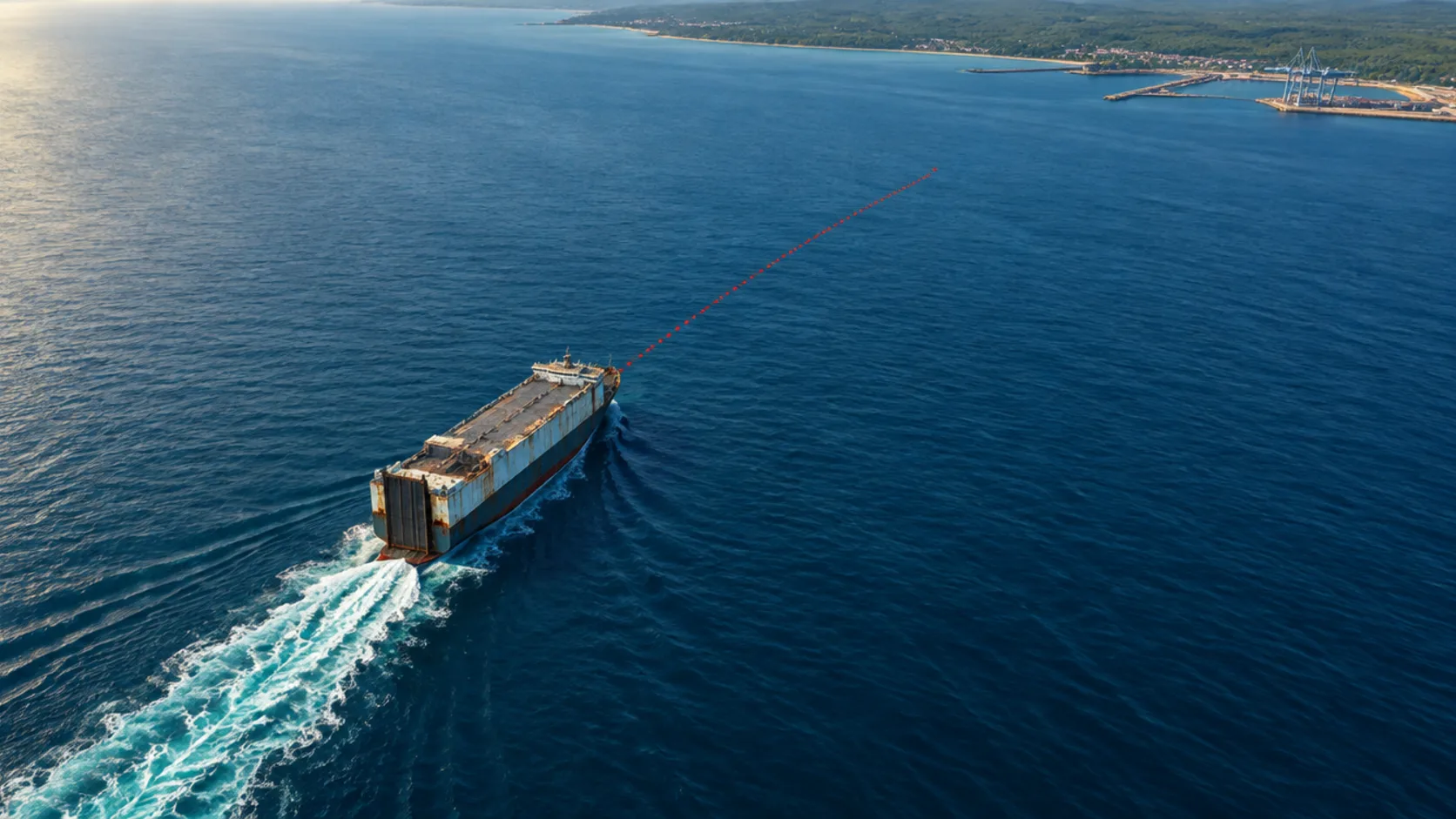
This research brief summarises an investigation by Follow the Money with Dossier Center, Danwatch, Delfi and Süddeutsche Zeitung, earlier reporting by Bellingcat, and the official documents cited. The Ledgers has not independently reviewed the confidential maritime documents or passenger data the consortium describes; the conclusion that identities were fabricated is the consortium’s and has not been confirmed by any authority. The illustration is AI-generated and does not depict an actual event or person.
Submit a response or correction ↗Reader comments
Verified members can comment. Comments appear after editorial approval. Please address the evidence and avoid personal information.
No published comments yet.
Sign in / Create account →Stay with the story.
Follow The Ledgers for new investigations, developments in our case files and videos.